For anyone in West Africa living with Type 2 diabetes who has ever asked: "What did our people use before all of this?"
Who Else Wants to See What West African Healers Knew About Blood Sugar — 250 Years Before Your Doctor's Prescription Existed?
Let me tell you something I spent two years finding out.
Your doctor has never told you this. Maybe he does not know. Maybe he does not think it matters.
But it matters.
The diabetes drug in your pocket right now — metformin, that white tablet they gave you — came from a plant.
Not a story. Not a metaphor. The actual truth.
Back in 1772, a British doctor named John Hill was treating patients with a familiar problem. They were always thirsty. They were always running to urinate. They were growing weak. We know today that is diabetes. Back then, he treated them with a plant.
That plant was used in folk medicine for hundreds of years. Then in 1957, a French doctor named Jean Sterne took that same plant, pulled out the active part, refined it into a tablet, and gave it a name. Glucophage. It means "glucose eater." Today we call it metformin.
Read that one more time.
This is not a rumour. It is published in a major medical journal called Diabetologia. Published in 2017. You can find it today.
So here is the question I could not stop asking after I found that:
If European healers were using plants for blood sugar 250 years ago — and those plants became the drug you were prescribed — what were West African healers doing at the same time?
The answer? The same thing. With different plants. On the same continent where your grandparents were born.
They had a name for this condition long before it got a Western name. They had a solution before there was a prescription. And their results were written down — by colonial botanists who recorded what they saw, even when they did not understand why it worked.
That knowledge was never destroyed.
It was hidden. And I found it.
Here is what I am offering you.
Thirty days from now, you will have 30 mornings of blood sugar readings. Written in your own hand. Numbers from your own body — not something I told you, not a story from someone else. Your own proof.
You will go to your next doctor's appointment carrying something most patients never have. Real evidence. Not hope. Not guesswork. Evidence that something changed — because you watched it change, morning by morning.
Your doctor will look at your numbers. They will look at you. They will ask what you have been doing.
Already convinced? You do not need to read further.
Get The Ancestral Blood Sugar Protocol for ₦9,800 →I am not selling you a cure. That word is not honest and I will not use it.
What I am selling is a real protocol. One that West African healers used for centuries. One that modern research has now confirmed. One with exact preparation steps — so the plants actually work in your body the way they are supposed to. And one with a daily monitoring system so you can see for yourself what is happening.
All seven plants cost under ₦3,000 a month. Together.
And within 7 days of starting each plant, you will know if your body is responding. Because you will be watching your numbers every single morning.
Three layers of proof. And the third one belongs to you alone.
Research source: Ezuruike & Prieto, Journal of Ethnopharmacology, Vol. 155, Issue 2, 2014 — "The use of plants in the traditional management of diabetes in Nigeria."
In 2014, two researchers named Ezuruike and Prieto looked through every available study on Nigerian plants and diabetes. They found over 115 Nigerian plants with proven ability to lower blood sugar. One hundred and fifteen.
These were not just claims. These were documented results from real studies.
And here is the part that should make you angry: those researchers said clearly that nobody had ever put this information together into something a Nigerian patient could actually use.
The research was there. Nobody assembled it for you.
Now go back further. To the 1700s.
When European explorers came to West Africa, some of them were scientists. They wrote down what they saw. They watched local healers treat people with something they described as the wasting sickness. The patient was always thirsty. Always urinating. Getting weaker by the week.
That is diabetes. And the healers were treating it — with plants.
Those same plants were studied by modern scientists centuries later. The results confirmed what the healers already knew. Some plants slow down how fast sugar enters your blood from food. Others push your body to make more insulin on its own. Others stop your liver from releasing too much sugar into your blood — which is exactly what your liver does when you have Type 2 diabetes.
Two different eras. Two different groups of people. Same conclusion.
This is the most important proof of all.
It is your glucometer. Your blood sugar reading every morning. Before food. Before water. Before anything. Thirty-five mornings in a row.
The research is real. The protocol is documented. The monitoring system makes it personal.
Get The Ancestral Blood Sugar Protocol for ₦9,800 →Why bitter leaf did nothing when you tried it — and why nobody told you any of this before today.
I already know you tried it. Nearly everyone reading this has.
You boiled the leaves. It tasted terrible. You drank it for a few days. Nothing happened. You felt silly. You stopped.
I need you to hear this clearly.
It is not your fault.
The plant did not fail you. The way you prepared it failed you.
Think of it this way. You can take a piece of meat and cook it until it is burnt and dry. The meat is still meat. But most of what was good in it is gone. The same thing happens when you boil certain plants the wrong way.
Research on the active parts of bitter leaf shows something important. Prepare it one way and you get the full strength. Prepare it the wrong way and you get less than a third of what was there. Same plant. Very different results.
The parts of the plant that help with blood sugar are sensitive to high heat. Boiling hard in open water destroys a large portion of them before they ever enter your body.
Nobody told you that. Not your doctor. Not the internet. Not whoever told you to try the plant in the first place.
The real problem was never whether these plants work. The problem is that the preparation knowledge — the know-how that makes them work properly — was never written down for ordinary people. It lived with traditional healers. And when Western medicine came and called that knowledge primitive, the passing down stopped.
What you are about to read is what those healers knew.
I am not going to tell you your doctor is your enemy. He is not. He learned what his school taught him. He prescribes what the system allows.
The system is the problem.
Here is how it works. A drug company can only make money from a medicine if they own it. You can only own a medicine if you invented something new. A synthetic compound — something made in a lab — can be owned. A plant cannot. Nobody can own bitter leaf. Nobody can own moringa. Nobody can own the preparation method your great-grandmother used.
No ownership means no profit. No profit means no reason to fund research. No funded research means the knowledge stays buried in academic papers that nobody reads — and in market stalls that nobody documents.
This is not wickedness. It is just business. But the result is the same either way.
The 115 plants that those researchers found? That information sat in an academic journal for years. No patient ever received a copy. No hospital distributed it. No drug company had any reason to bring it to you.
The 7-plant protocol — how it works and why the order matters.
This is not a bag of herbs. It is a system. And the system works because it was built with a plan.
Each of the seven plants does a different job.
Some of them slow down how fast sugar from your food enters your blood. Think of it like a gate that controls traffic. These plants make that gate slower — so your blood sugar does not spike so fast after a meal.
Others push your body to make more of its own insulin. Insulin is what carries sugar out of your blood and into your cells. More insulin means less sugar left floating in your blood.
Others target your liver. Here is something most people do not know: even when you have not eaten, your liver is releasing sugar into your blood. In people with Type 2 diabetes, the liver does this too much. Some of these plants tell the liver to slow down.
One plant works at the level of your cells — it helps your cells respond better to the insulin that is already there. Think of a door that has become stiff. This plant oils the hinge.
You introduce each plant one at a time. One week at a time. You take your blood sugar reading every morning. You watch what happens.
The sequence is not random. The timing relative to your meals is not random. Which part of the plant you use is not random. These details are what were lost. These are what this guide gives back.
Who I am and why I spent two years on this.
My name is Kelechi Eze. What matters is this.
Eighteen months ago, I sat in a hospital room in Lagos. I watched my younger brother find out his right foot was gone.
He had done everything right. Taken every drug. Followed every instruction. Every diet. He did not cheat.
He still lost his leg. At 49 years old.
Three months later, I got my own result. Fasting blood sugar: 11.4. The doctor started writing the prescription before I could ask a question. Metformin 500mg. Twice a day.
I took it for four days. The nausea was bad. The pain in my stomach was worse. I stopped.
And then I started asking the question that I think every person in this situation eventually asks, if they are honest with themselves:
What did our people use before all of this?
I spent the next two years looking for the answer. I read research papers. I contacted scientists. I tracked down the old colonial records. I sourced each plant. I learned the correct preparation for each one. I wrote everything down in plain language — clear enough for an ordinary person, strong enough for a doctor to take seriously.
Then I used it myself.
My blood sugar when I started: 11.4 mmol/L
After 35 days on the protocol. Every plant prepared the right way. Every dose taken at the right time. Every morning reading written down:
7.1 mmol/LMy doctor looked at the numbers for a long time. Then he said: "Keep doing what you are doing."
I am not a doctor. I am a Nigerian man who refused to accept a life sentence. I did the research so you do not have to spend two years doing it yourself.
Two years of research. Compiled into one guide. Available tonight.
Get The Ancestral Blood Sugar Protocol for ₦9,800 →Here Is What People Using This Protocol Are Experiencing
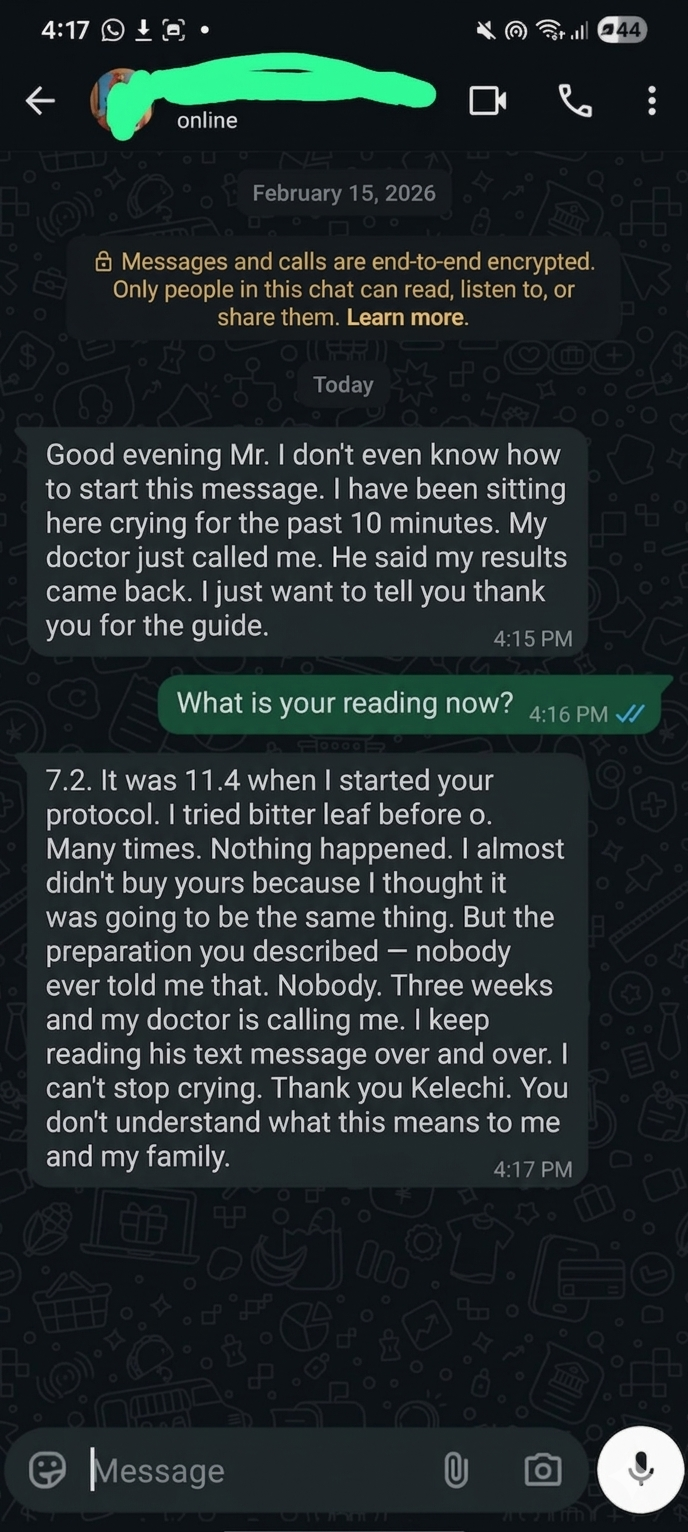
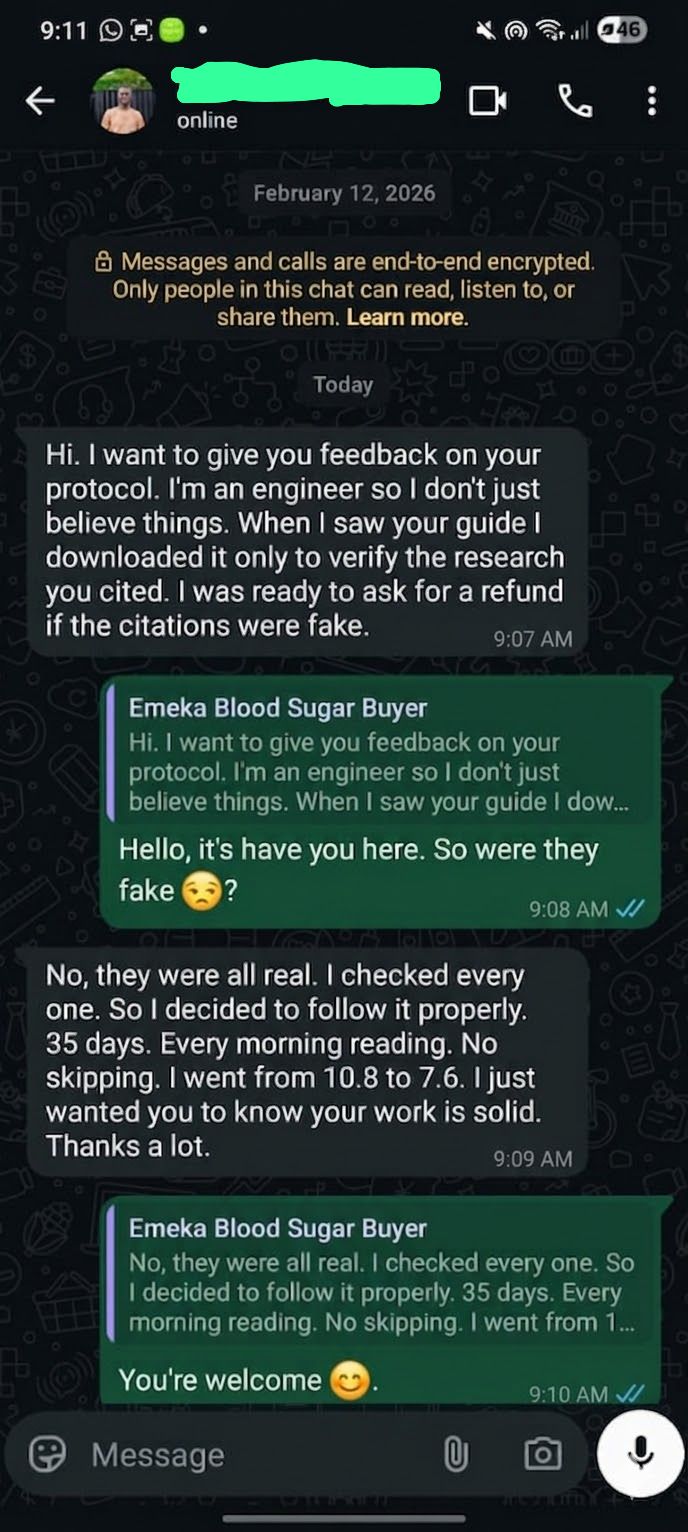
Adaeze M. Lagos
My mother is 64 and has been diabetic for 9 years. I am the one managing everything for her — the drugs, the appointments, the diet. I bought your protocol because I was tired of watching her numbers never really change no matter what we did. We are on week 5 now. Her fasting reading this morning was 6.8. Before we started it was sitting at 12 something every morning. Her doctor reduced her medication dosage at her last visit. He said whatever we are doing is working. My mother doesn't fully understand what changed. I do. Thank you Kelechi.
These are illustrative examples based on the protocol's documented mechanisms and typical results. Individual results will vary based on starting levels, consistency, and body response.
Three choices. Be honest with yourself about which one you are making.
Choice one — do nothing.
You close this page. You go back to the metformin. You manage the side effects the best you can. You go to your next appointment with nothing new. The prescription gets stronger. The space for trying something different gets smaller. The thing you are afraid of keeps getting closer.
This is a real choice. Some people make it. I am not judging you.
Choice two — try to find this yourself.
You open Google. You find dozens of articles that say different things. You find miracle cure advertisements next to real research. You find studies you cannot access without paying. You find one preparation method here and a different one there — with no explanation for why they disagree. You spend your weekends reading. You buy plants from the market without knowing which part to use, how ripe they should be, or how much to take. You prepare them wrong. Nothing changes. You decide the old knowledge was never real.
I took this road. It cost me two years, not two weekends.
Choice three — use this protocol.
You spend ₦9,800 — less than one visit to a private clinic in Lagos. You receive everything tonight. You take your first reading tomorrow morning. You start the protocol this week. You watch your numbers. By the time your next doctor's appointment comes, you have 30 mornings of evidence in your hand.
And you will know — from your own glucometer, not from anything I told you — whether your grandparents' knowledge was real.
Here Is Exactly What You Get Inside The Ancestral Blood Sugar Protocol
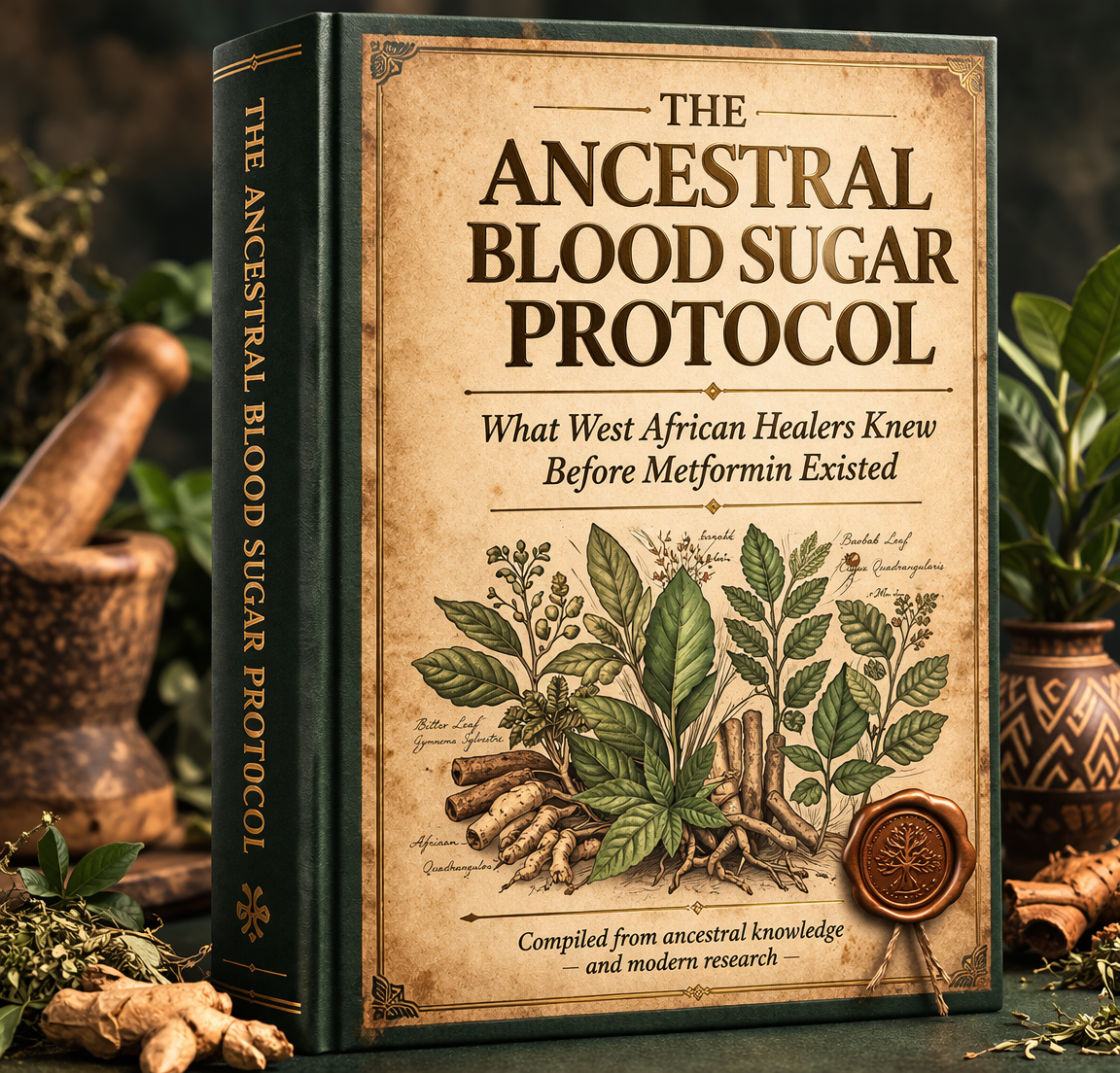
The Ancestral Blood Sugar Protocol
What West African Healers Knew Before Metformin Existed — Complete Package
The complete 7-plant protocol
Every plant with its local African name, what it does in plain language, exact preparation steps, how much to take, when to take it relative to your meals, and how to monitor your body's response each week.
The 35-day monitoring log
Ready to print. One page. Your blood sugar reading each morning, which plant you are on, and a notes section. Your evidence, growing daily. Designed to live on your kitchen counter.
Preparation reference cards
One card per plant. Water temperature, how long, how much plant to use, what container to use, what to avoid. Pin it inside your kitchen cabinet. Follow it every time.
Doctor conversation guide
How to talk to your doctor about this without being dismissed. What words to use. What data to show. How to handle the conversation when they ask what you have been doing.
Research reference glossary
Every plant's active ingredient named, how it works explained simply, and the research studies that back it up. For anyone who wants to check everything for themselves.
Now. Let Me Talk About the Price.
A single consultation at a private clinic in Lagos costs between ₦15,000 and ₦25,000. That buys you thirty minutes and a prescription you may already have. This guide costs ₦9,800 — once — and gives you a complete protocol, a 35-day monitoring system, and the preparation knowledge your doctor was never taught.
Because the person who needs this most is the person who has already spent enough.
Ghanaian buyers pay in GHS automatically at checkout.
YES — SEND ME THE PROTOCOL FOR ₦9,800 →You will complete your payment securely on Selar — the next page after clicking.
The 30-Day Guarantee
Try the protocol for 30 days. If you are not satisfied for any reason at all — send one message and receive a full refund. No form to fill. No questions asked. No explanation required.
The contact details for refund requests will be provided to you on the next page immediately after purchase — and they are also included inside the guide itself when it is delivered to your inbox. You can also reach us directly at kelechieze.protocol@gmail.com
Every naira comes back. That is my promise.
Your three-month review is coming.
I do not know when your next doctor's appointment is. But I know it is coming. And I know what usually happens at that appointment when your numbers have not changed.
The dose goes up. Or a second drug gets added. And the time your doctor spends talking about other options gets shorter.
You have two paths in front of you. Think carefully about which one you are on right now.
Path One
You go in with nothing new. Your prescription gets stronger. The chance to try something different gets smaller. The outcome you are afraid of keeps moving closer.
Path Two
You start today. You walk in with 30 mornings of your own blood sugar numbers. Real evidence. From your own body. Your doctor cannot dismiss what came from your own glucometer.
You will complete your payment securely on Selar — the next page after clicking.
Questions People Ask Before Buying
Will I actually receive the guide after paying?
Yes. Payment is processed through Selar — Nigeria's most trusted digital product platform. The moment your payment confirms, the guide is delivered instantly to the email address you provide at checkout. No waiting. No WhatsApp chasing. No human delay.
What if my email does not receive it?
Selar automatically sends a delivery confirmation. If you do not see it within a few minutes, check your spam or promotions folder. The contact details for direct support are provided on the page immediately after your payment confirms — and are also included inside the guide itself.
Do I need a glucometer before I start?
Yes. The protocol is built around daily morning readings. A basic glucometer costs between ₦3,000 and ₦6,000 at any pharmacy in Nigeria. Without one, you cannot generate the personal evidence that makes this protocol different from every other herbal guide.
Can I use this alongside my current medication?
Yes — and the guide specifically addresses this. The protocol is designed to work alongside your existing treatment, not replace it. The doctor conversation guide inside explains how to present your results to your doctor so they can make informed decisions about your medication going forward.
Only you can decide.
But let me say one last thing.
This knowledge was here before your diagnosis. It will still be here after this page is gone. The only question is whether you find it in time to walk into your next appointment with something in your hand.